






Guide to Seaside Flowers (Identification Chart)
- Series : FSC IDENTIFICATION CHARTS
- Publisher : Field Studies Council
- Illustrations : col photos, col illus


Our customers have not yet submitted a review for this title - click here to be the first to write a review
Description:
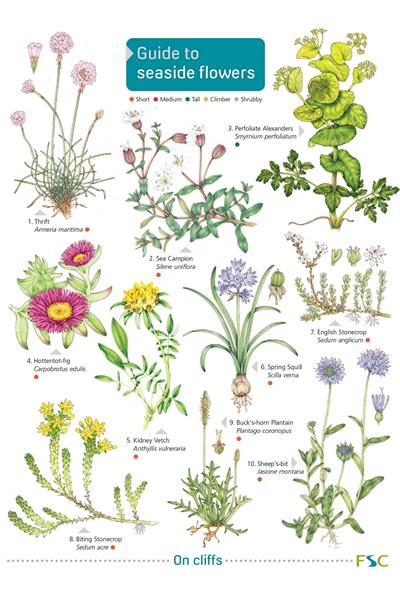
Illustrations by Lizzie Harper. FSC Seaside flowers fold-out guide features 38 special flowers of cliffs, sand dunes, saltmarshes and shingle beaches.
Beautiful colour paintings by Lizzie Harper show the key features of each plant, including flowers, leaves and stems. Accompanying text on the reverse side highlights the important features to look out for. Use this concise fold-out guide to quickly put a name to the flowers that you see.
For the plant hunter, the seaside is a fascinating place to explore. Many of the flowers found at the coast don’t live anywhere else. From Buck’s-horn Plantain and Biting Stonecrop to Viper’s Bugloss and Yellow-horned Poppy, there are flowers to spot all year round. On cliffs and sand dunes, the best displays of flowers are from April to July. But shingle and saltmarshes are at their best in the late summer and early autumn. Some seaside flowers occur throughout the coasts of Great Britain and Ireland, while others have a more restricted distribution.
Living besides the sea brings challenges. But some plants have evolved to survive in these tough conditions. Salt spray and salt-laden winds increase soil salinity, leaving plants vulnerable to water loss. Fleshy succulent leaves are a common adaptation. Since the soils of sand dunes, mobile shingle and estuary mud are unstable, many coastal plants are deep rooted. Increasingly some of these flowers occur inland, especially along roads treated with salt in winter. A few grow on the spoil heaps associated with old lead and zinc mines.
Other titles from the series : FSC IDENTIFICATION CHARTS
Click to view all titles in this series...


Guide to the British Stonefly (Plecoptera) families: adults and larvae
Pryce, D.; Macadam, C.; Brooks, S.
Price £4.00


You may also like...


Pinguicula of Latin America
Lampard, S.; Gluch, O.; Robinson, A.S.; Fleischmann, A.; Temple, P.; McPherson, S.; Roccia, A.; Partrat, E.; Legendre, L.
Price £39.99


Drosera of the World. Vol. 1-3
Lowrie, A.; Robinson, A.; Nunn, R.; Rice, B.; Bourke, G.; Gibson, R.; McPherson, S.; Fleischmann, A.
Price £169.99