





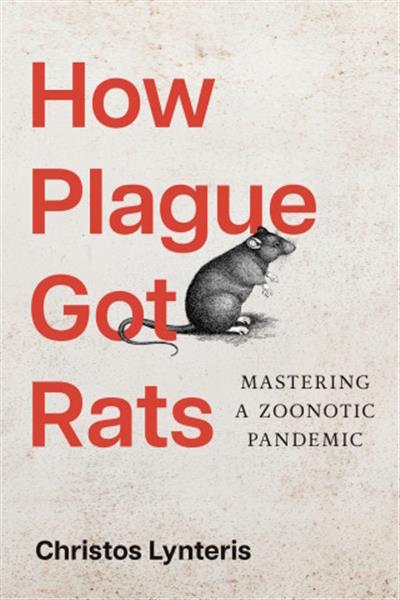
How Plague Got Rats: Mastering a Zoonotic Pandemic
- Series : Epidemic Histories
- Publisher : Johns Hopkins University Press
- Illustrations : 5 b/w photos, 7 b/w illus, 2 maps


Our customers have not yet submitted a review for this title - click here to be the first to write a review
Description:
How modern epidemiology was born through the unlikely rise of the plague rat.
Today, rats are nearly synonymous with plague, but this association is surprisingly recent. For centuries, plague devastated populations without being linked to animals. So how did the rat become the symbol of one of history's deadliest diseases? In this book, Christos Lynteris unravels this story by focusing on the Third Plague Pandemic, a global outbreak that began in China in the 1850s and claimed an estimated 15 million lives by the mid-twentieth century.
This was the first major pandemic recognised by scientists as zoonotic, spread from animals to humans, and it marked a turning point in both medical science and global health. Through a gripping historical investigation, Lynteris explores how rats entered the medical imagination of the time. He reveals how scientific thinking about disease vectors evolved in tandem with colonial power structures as plague responses unfolded across Asia, Africa, and the Americas. From laboratory discoveries to imperial interventions, the rat became central not just to understanding plague, but to shaping new forms of epidemiological reasoning.
This provocative book shows how zoonosis emerged as a politically charged concept in the context of empire and pandemic crisis. It is a powerful history of how science, society, and colonialism converged around a creature now inseparable from the story of epidemic disease.
You may also like...

Little Beasts: Art, Wonder, and the Natural World
Libby, A.; Rich, B.; Sell, S.
Price £31.50
(Save £10.50)

Connecting Territories: Exploring People and Nature, 1700-1850 (Emergence of
Boscani Leoni, S.; Baumgartner, S.; Knittel, M. (Eds)
Price £126.40

The Natuurkundige Commissie in the Netherlands Indies (1820-1850) (Emergence of
van Wingerden, P.
Price £116.00

Radical by Nature: The Revolutionary Life of Alfred Russel Wallace
Costa, J.T.
Price £28.00
(Save £7.00)

Impossible Monsters: Dinosaurs, Darwin and the War Between Science and Religion
Taylor, M.
Price £12.99
