





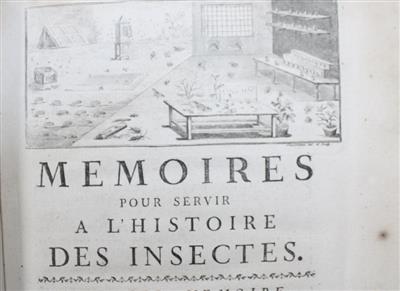
Memoires pour servir a l'histoire des Insectes Tome I: Sur les chenilles et sur les papillons
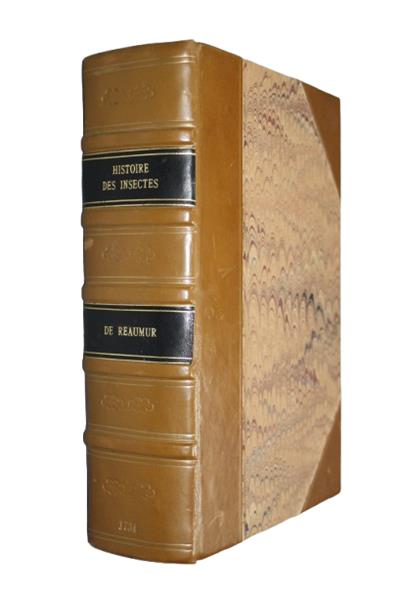
- Publisher : Imprimerie Royale
- Published In : Paris
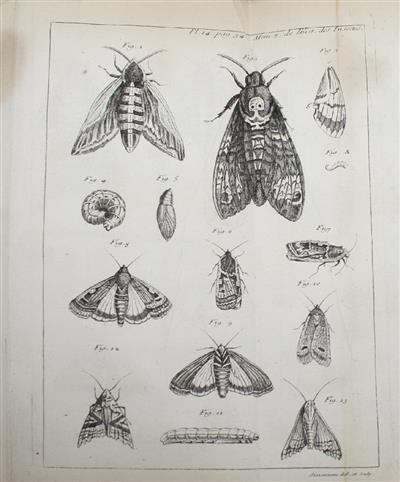
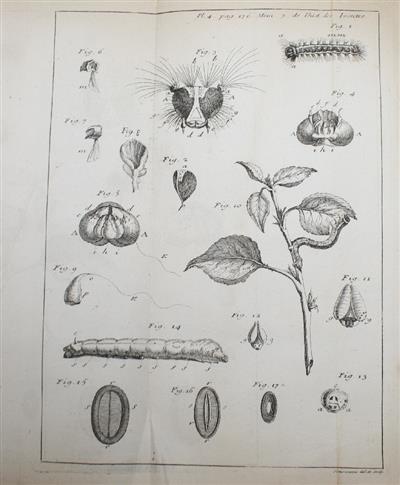
- Illustrations : 50 folding engraved plates


Description:
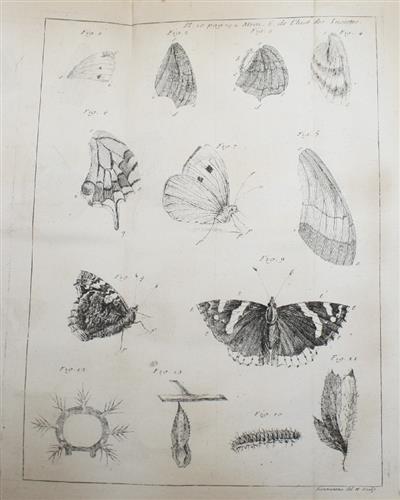
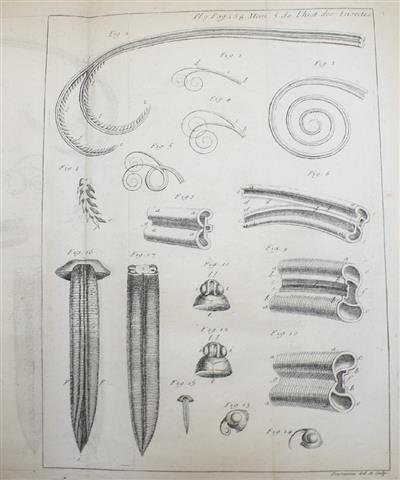
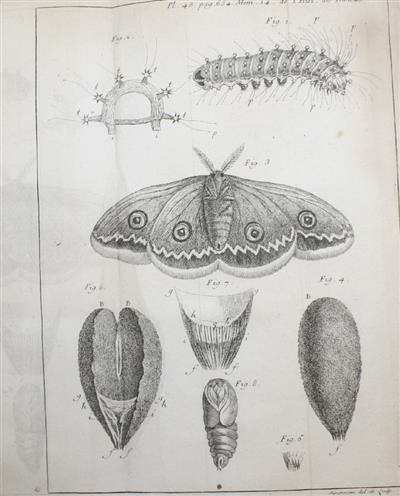
Vol. I only - Tome I: Sur les chenilles et sur les papillons. First edition of the first volume of Réaumur's celebrated Mémoires pour servir à l'histoire des insectes, published in six volumes 1734-1742, one of the foundational works of eighteenth-century entomology. René-Antoine Ferchault de Réaumur was among the most important experimental naturalists of his age and approached the study of insects through prolonged observation of living specimens, experiment and detailed investigation of their structure, behaviour and life histories. This opening volume is specifically devoted to caterpillars, chrysalides, butterflies and moths. The 50 folding engraved plates, are drawn and engraved by Philippe Simonneau (1685-1753), draughtsman and engraver to the Académie des Sciences and engraver to the King, The 50 folding engraved plates provide remarkably detailed representations of caterpillars, chrysalides, adult butterflies and moths, together with anatomical details, behaviour and the structures constructed by larvae.
The volume comprises fourteen memoirs which together trace the insect from the caterpillar through metamorphosis to the adult butterfly or moth: 1. a general introduction to the history and study of insects, setting out Réaumur's aims, methods and proposed arrangement of the work ; 2. caterpillars in general and their division into classes and genera; 3. the different parts and anatomical structures of caterpillars; 4. the changes of skin undergone by caterpillars during growth; 5. the external parts of butterflies, particularly the wings, eyes, antennae and proboscis; 6. the characters by which butterflies may be divided into classes, genera and species, including the principal groups of diurnal butterflies ; 7. the characters of the classes and genera of phalaenae, or nocturnal butterflies and moths; 8. chrysalides in general and an examination of what actually takes place during the transformations of caterpillars into chrysalides and chrysalides into butterflies ; 9. the various precautions and devices employed by caterpillars in preparing for metamorphosis, together with the emergence of the chrysalis from the caterpillar skin and the respiration of chrysalides; 10. caterpillars which suspend themselves vertically by the hind end before metamorphosis, the attachment of the resulting chrysalis by its tail, and an investigation of the brilliant golden colour found in some chrysalides ; 11. caterpillars which secure themselves for metamorphosis by means of a silken girdle around the body, and the similarly suspended chrysalides which result; 12. the construction of rounded cocoons of pure silk or of silk mixed with hairs, within which various caterpillars transform into chrysalides; 13. the construction of unusually shaped silk cocoons and of cocoons incorporating materials other than silk; and 14. the transformation of chrysalides into adult butterflies and moths.
Réaumur's interest extends far beyond description and classification. He investigated how caterpillars move, feed, moult and breathe; the microscopic structure of butterflies and their wings; the production and use of silk; the different methods by which larvae secure themselves before pupation; the construction of cocoons; and the physical processes involved in metamorphosis and emergence. Particularly characteristic of Réaumur is his treatment of insect 'industry' - the apparently ingenious behaviours by which caterpillars prepare themselves for the vulnerable pupal stage. His observations were based to a remarkable degree on insects reared and watched through their complete life cycles.
Published twenty-four years before the tenth edition of Linnaeus's Systema Naturae established the conventional starting point of modern zoological nomenclature, Réaumur's work belongs to the great pre-Linnaean tradition of observational and experimental natural history. His purpose was not principally to name species, but to understand the living insect: its anatomy, development, behaviour and relationship with its surroundings. In this respect the Mémoires had a profound influence on subsequent entomological study.
Tome I only of six, but a substantial and coherent volume in its own right, devoted throughout to the biology of Lepidoptera and particularly notable for its detailed treatment of caterpillar development and metamorphosis.
Nissen ZBI 3315; Horn & Schenkling 17767.
Condition
4to, recent half calf, leather title-pieces to spine, gilt lettering, marbled boards, new endpapers. Some minor offsetting and light scattered foxing. Faint old stain to the top of a few leaves and plates (not affecting text/illustrations). One plate with some edgewear. Very good.
You may also like...


Insects of Britain and Europe: A Field Guide
John, T.C.; Mullen, P.; Brock, P.D.
Price £18.50
(Save £6.50)

Insect Architecture: How Insects Build, Engineer, and Shape their World
Jackson, T. (Auth.); Engel, M. (Ed.)
Price £18.75
(Save £6.25)

Britain's Insects: A field guide to the insects of Great Britain and Ireland
Brock, P.D.
Price £17.50
(Save £7.50)

A photographic guide to Insects of southern Europe and the Mediterranean
Brock, P.D.
Price £24.50
(Save £3.00)

Insect Movement: Mechanisms and Consequences
Woiwod, I.P.; Reynolds, D.R.; Thomas, C.D. (Eds)
Price £20.00
(Save £140.80)