





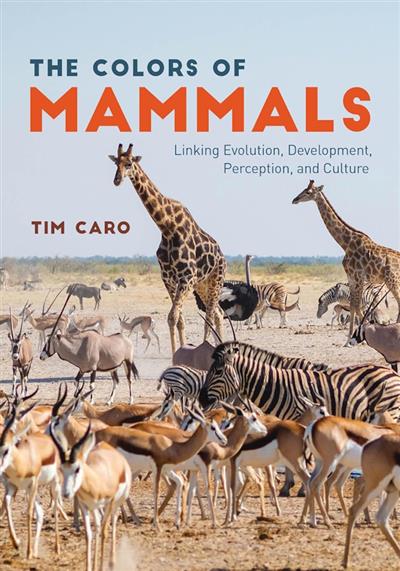
The Colors of Mammals: Linking Evolution, Development, Perception, and Culture
- Publisher : University of Chicago Press
- Illustrations : 139 col plates, 4 b/w illus, 26 line drawings, 52 tables


Our customers have not yet submitted a review for this title - click here to be the first to write a review
Description:
A principal colouration scientist offers a comprehensive and beautifully illustrated synthesis of colouration in mammals, weaving together contemporary research on evolution, underlying genetics, visual systems, and relevance to humans.
Why are giant pandas black and white, mandrills red and blue, but mice brown? How do mammalian colours and patterns develop? And why do we see in three colours, but deer do not? A cadre of evolutionary scientists, including geneticists, behavioural ecologists, visual ecologists, and anthropologists, have worked for over a century to answer these and other questions about the origin and functions of mammal colouration in nature. One of them is celebrated biologist Tim Caro, who has studied animal colouration for over three decades. In this landmark book, he presents a synthesis of experimental and observational studies to explain how and why animal colouration has evolved for three primary reasons: protection against predators, communication, and to respond to environmental factors. Furthermore, Caro provides accessible descriptions of the various genetic and visual mechanisms that have shaped mammals' extraordinarily diverse colours and patterns.
Victorian naturalists were the first to recognise that colouration influences individuals' survival and reproduction, and this led to an explosion of research on its adaptive significance a century later. Then, at the beginning of the twentieth century, biologists began to work on the genomic and developmental basis of colouration. Since then, genetic studies on model organisms, particularly mice, have led to a deep understanding of the genes regulating the production of melanin pigments and, lately, pattern formation. Simultaneously, scientists have studied organisms' colour perception. However, these functional, molecular, and mechanistic approaches rarely overlap, as they historically emanate from different areas of science. In this book, Caro ties these areas of research together for the first time. Caro outlines perception and production of colour; teases apart different aspects of protective colouration; discusses social and sexual signalling; explores environmental drivers of colouration in nonhuman mammals, including domesticated species; and discusses human biology and our use of colour in clothing. The resulting volume offers readers both a holistic view of today's science and an honest assessment of the remaining questions for future research.
You may also like...


Elephants and Their Fossil Relatives: A 60 Million Year Journey
Larramendi, A.; Ferretti, M.P.
Price £28.00
(Save £7.00)


Mammals of Madagascar
Mittermeier, R.A.; Langrand, O.M.; Wilson, D.E.; Rylands, A.B.; Ratsimbazafy, J.; Reuter, K.E.; Andriamanana, T.; Louis, E.E.; Schwitzer, C.; Sechrest, W.
Price £24.00
