





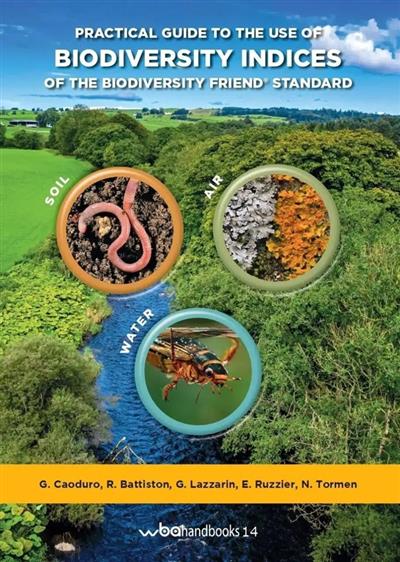
Practical guide to the use of Biodiversity Indices of the Biodiversity Friend Standard
- Series : WBA Handbooks
Volume: 14 - Publisher : World Biodiversity Association
- Illustrations : 153 photos + illus


Our customers have not yet submitted a review for this title - click here to be the first to write a review
Description:
In 2010, when the UN declared the International Year of Biodiversity, WBA proposed to the world of agriculture a new certification standard based on the environmental, social, and economic sustainability of agrosystems: Biodiversity Friend. This field guide illustrates the methods of application of the Biodiversity Indices of the BF standard, through the survey of the biological communities of particular organisms defined as bioindicators. These indices are able to provide useful indications on the degree of alteration of air, water, and soil.
Up to now, the Biodiversity Friend standard and the Biodiversity Indices have been applied in hundreds of farms in Italy, in Europe, and also in tropical environments, contributing to creating in farmers, the true custodians of the territory, a new awareness of the importance of protecting biodiversity for the quality of products and for the perpetuation of life on Earth.
Many of the readers of this volume will have found themselves wondering about the environmental quality of a protected area, or a region with different degrees of anthropisation. Learning to ‘read the signs of biodiversity’ is one of the main objectives of this manual.
From a perspective of active citizenship, the use of the Biodiversity Indices also allows one to understand how epiphytic lichens, aquatic macroinvertebrates, and soil fauna are useful in giving information on the quality of air, water, and soil of a territory: from the observation of their presence or absence, each of us can evaluate simply and autonomously the healthiness of the environment in which we live.
Specifically, the analysis of lichen communities present on tree trunks, of aquatic macroinvertebrate communities present in surface watercourses and of soil-dwelling invertebrate communities can provide very useful information to evaluate anthropogenic impact on natural, rural and urban environments. Moreover, the contents of this manual may represent an effective educational tool to teach young people careful observation of nature, to discover its wonderful forms and to understand the state of alteration of an environment.
Other titles from the series : WBA Handbooks
Click to view all titles in this series...

European bark and ambrosia beetles / Scolitidi d'Europa: types, characteristics
Faccoli, M.
Price £28.50

Dragonflies and Damselflies of Europe: A scientific approach to the
Galliani, C.; Scherini, R.; Piglia, A.
Price £48.00

Grasshoppers and crickets of Italy: A photographic field guide to all the
Iorio, C.; Scherini, R.; Fontana, P.; Buzzetti, F.M.; Kleukers, R.; Ode, B.; Massa, B.
Price £44.50


Orthopterans of Oaxaca: Photographic Field Guide - Ortopteros de Oaxaca Guia
Fontana, P.; Buzzetti, F.M.; Marino-Perez, R.; Castellanos-Vargas, I.; Monge-Rodriguez, S.; Cano-Santana, Z.
Price £26.50

Farfalle d'Italia: Riconoscimento, stadi giovanili, ecologia e distribuzione
Paolucci, P.
Price £49.50
You may also like...


An Illustrated Book of Peat: The Life and Deaths of Bogs: A New Synthesis. Vol.
Fenton, J.H.C.
Price £44.95


Mini-Forest Revolution: Using the Miyawaki Method to Rapidly Rewild the World
Lewis, H.
Price £16.99